About This Course

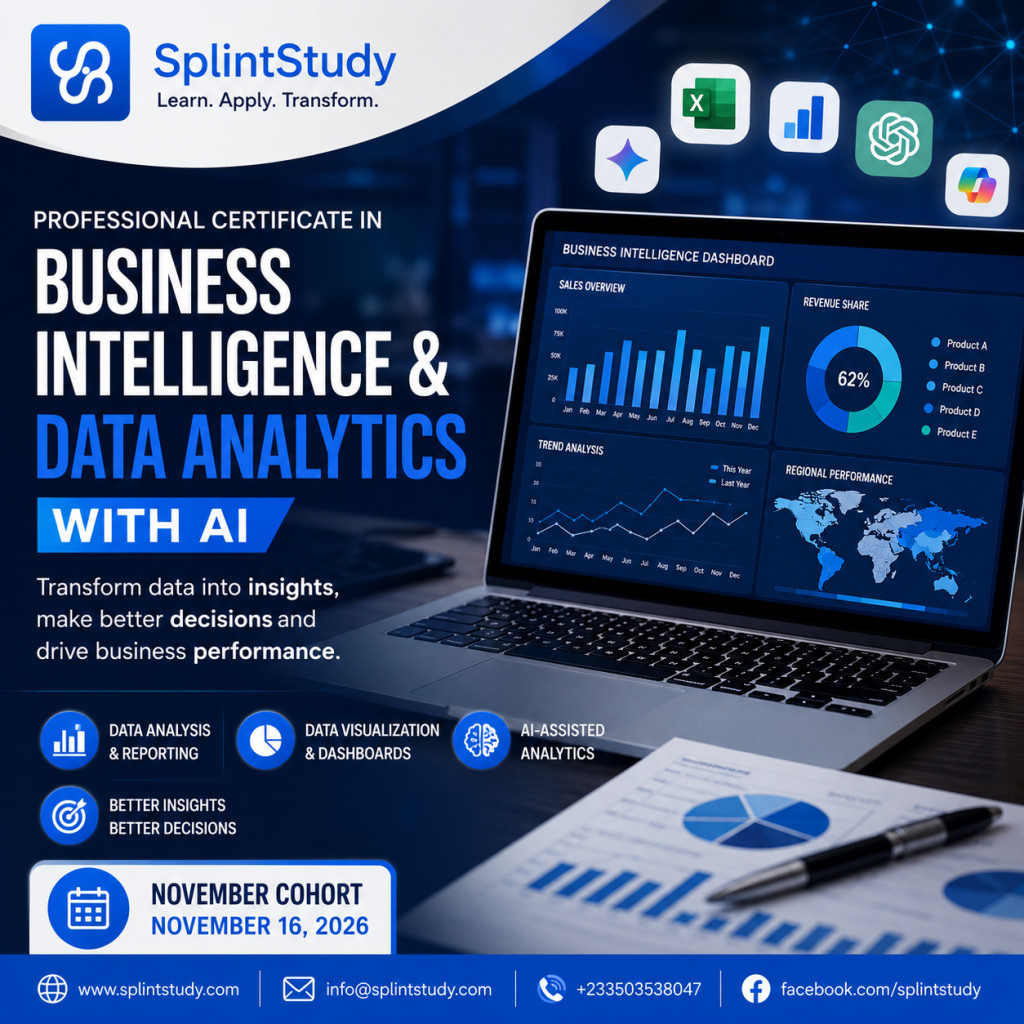
PROFESSIONAL CERTIFICATE IN BUSINESS INTELLIGENCE & DATA ANALYTICS WITH AI

Transform Business Data Into Powerful Insights, Better Decisions and Strategic Advantage

Data has become one of the most valuable resources for modern organizations.

Every organization generates data through customers, operations, finance, sales, marketing, employees and digital systems. However, the real competitive advantage does not come from simply collecting data.

The advantage comes from knowing how to transform data into meaningful insights that support better decisions.

The question is no longer:

Does your organization have data?

The real question is:

Do you have the skills to analyze data, discover insights and use intelligence to improve business performance?

The Professional Certificate in Business Intelligence & Data Analytics with AI is a comprehensive, practical and instructor-led 8-week programme designed to help professionals develop the ability to collect, prepare, analyze, visualize and interpret business data using modern analytics approaches and Artificial Intelligence.

This programme combines Business Intelligence, Data Analytics, Excel Analytics, Business Metrics, KPI Development, Data Visualization, AI-Assisted Analytics, Reporting, Forecasting, Decision Support and Executive Insights into one integrated learning experience.

You will not simply learn how to work with spreadsheets and reports.

You will learn how to:

  • Understand business data.
  • Prepare and clean information for analysis.
  • Identify important business trends.
  • Develop meaningful KPIs.
  • Create professional reports and dashboards.
  • Use AI to improve analytics workflows.
  • Generate actionable business insights.
  • Support strategic decision-making.

You will move beyond simply viewing data.

You will learn how to transform data into intelligence.

PROGRAMME AT A GLANCE

Programme:
Professional Certificate in Business Intelligence & Data Analytics with AI

Duration:
8 Weeks

Delivery:
Live Online — Instructor-Led

Level:
Beginner to Intermediate

Learning Approach:
Practical, Hands-On and Project-Based

Live Learning:
Three Interactive Sessions Per Week

Assessment:
Practical Exercises, Module Assignments, Participation, AI-Assisted Analytics Activities and Final Capstone Project

Capstone Project:
Business Intelligence Analytics Solution

Award:
Professional Certificate

Prerequisite:
No advanced programming or technical background required

DEVELOP THE SKILLS TO MAKE DATA-DRIVEN DECISIONS

Organizations today operate in an environment where decisions must be faster, smarter and supported by evidence.

From finance and accounting to marketing, operations, healthcare, education, government and entrepreneurship, professionals who understand how to use data effectively are becoming increasingly valuable.

However, knowing how to create a spreadsheet or generate a report is not the same as being able to perform professional business analytics.

The real value lies in knowing how to:

  • Identify important business questions.
  • Understand different types of business data.
  • Prepare and organize data for analysis.
  • Develop meaningful performance indicators.
  • Analyze trends and patterns.
  • Interpret business results.
  • Create dashboards and reports.
  • Communicate insights effectively.
  • Use AI to improve analytical workflows.
  • Support strategic decisions.

This programme is designed to develop these practical capabilities.

Through live instructor-led classes, guided demonstrations, analytical exercises, business case studies, practical laboratories and a professional capstone project, participants will develop the confidence and competence to apply Business Intelligence and Data Analytics in real organizational contexts.

WHY THIS PROGRAMME?

The modern workplace does not only need people who can collect data.

Organizations need professionals who can connect:

Data + Analysis + Business Understanding + Artificial Intelligence = Better Decisions

This programme bridges the gap between basic spreadsheet usage and advanced technical data science.

Rather than focusing only on tools, this programme develops the complete business analytics mindset.

Participants learn how to combine:

BUSINESS INTELLIGENCE KNOWLEDGE

Understand how organizations use data, information systems and analytics to improve performance.

DATA ANALYTICS SKILLS

Learn how to collect, clean, analyze and interpret business information.

BUSINESS METRICS & KPIs

Understand how organizations measure success and monitor performance.

DATA VISUALIZATION

Transform complex information into clear dashboards and reports.

AI-ASSISTED ANALYTICS

Use Artificial Intelligence to improve analysis, reporting and decision-making.

BUSINESS STORYTELLING

Communicate insights in a way that supports management decisions.

STRATEGIC DECISION SUPPORT

Move from reporting what happened to understanding what should happen next.

WHAT MAKES THIS PROGRAMME DIFFERENT?

  1. PRACTICAL BUSINESS APPLICATION, NOT JUST THEORY

Many analytics programmes focus heavily on technical concepts.

This programme focuses on how analytics is used to solve real business problems.

Every module connects:

Concepts → Frameworks → Practical Applications → Business Decisions

Participants learn through:

  • Real-world business scenarios.
  • Practical datasets.
  • Analytics exercises.
  • Reporting activities.
  • Dashboard development.
  • AI-assisted analysis.
  1. THREE LIVE LEARNING SESSIONS EVERY WEEK

The programme follows a structured three-session learning model.

Each week contains:

SESSION 1

Concepts, Principles & Foundations

Participants learn:

  • Core concepts.
  • Analytical principles.
  • Business frameworks.
  • Industry applications.

SESSION 2

Strategies, Frameworks & Professional Applications

Participants learn how analytics supports:

  • Management decisions.
  • Business improvement.
  • Performance measurement.
  • Strategic planning.

SESSION 3

Practical Analytics Labs

Participants apply concepts through:

  • Excel analytics.
  • AI-assisted analysis.
  • Reporting exercises.
  • Dashboard development.
  • Practical business cases.

This ensures participants develop both analytical understanding and practical capability.

  1. BUSINESS-FOCUSED ANALYTICS APPROACH

The programme focuses on solving problems across multiple industries:

  • Finance.
  • Accounting.
  • Banking.
  • Marketing.
  • Sales.
  • Operations.
  • Education.
  • Healthcare.
  • Government.
  • NGOs.
  • Entrepreneurship.
  • Professional services.

Participants learn how analytics creates value in different organizational environments.


  1. AI + ANALYTICS INTEGRATION

Modern analytics is evolving.

Artificial Intelligence is changing how professionals:

  • Explore data.
  • Generate insights.
  • Create reports.
  • Identify patterns.
  • Support decisions.

Participants learn how to use AI tools responsibly for:

  • Data interpretation.
  • Business analysis.
  • Report generation.
  • Insight discovery.
  • Executive communication.


  1. FROM REPORTING TO DECISION INTELLIGENCE

Traditional reporting answers:

"What happened?"

Modern Business Intelligence answers:

"Why did it happen?"

"What may happen next?"

"What should we do?"

This programme develops professionals who can move from reporting information to supporting decisions.

  1. PROFESSIONAL CAPSTONE PROJECT

The programme concludes with a practical Business Intelligence capstone project.

Participants develop a complete analytics solution including:

  • Business problem identification.
  • Data preparation.
  • KPI development.
  • Analysis.
  • Visualization.
  • AI-assisted insights.
  • Business recommendations.

The final project demonstrates the ability to apply Business Intelligence skills in a professional context.


WHAT YOU WILL LEARN

By the end of the programme, you will be able to:

  • Understand the principles of Business Intelligence and Data Analytics.
  • Explain how organizations use data to improve decision-making.
  • Identify different types of business data and their applications.
  • Understand business metrics, KPIs and performance measurement.
  • Collect, organize and prepare business data for analysis.
  • Clean, validate and transform data using professional approaches.
  • Apply Excel-based analytics techniques for business analysis.
  • Use advanced Excel functions for data analysis and reporting.
  • Create PivotTables, PivotCharts and interactive business reports.
  • Analyze business performance using descriptive, diagnostic and predictive approaches.
  • Apply AI tools to support data analysis and business insights.
  • Use AI assistants such as ChatGPT, Microsoft Copilot and Gemini for analytics workflows.
  • Develop professional dashboards and business reports.
  • Apply data visualization principles to communicate insights effectively.
  • Identify trends, patterns and opportunities from business data.
  • Develop meaningful KPIs for organizational performance measurement.
  • Create executive-level reports and summaries.
  • Apply forecasting techniques for business planning.
  • Use data storytelling to communicate analytical findings.
  • Translate analytical results into practical recommendations.
  • Support strategic decision-making using evidence-based insights.
  • Build AI-assisted analytics workflows.
  • Evaluate AI-generated insights for accuracy and relevance.
  • Design a complete Business Intelligence solution through a practical capstone project.

WHO SHOULD ENROL?

This programme is designed for professionals, entrepreneurs and students who want to develop practical Business Intelligence and Data Analytics skills.

It is particularly suitable for:

Business Professionals

  • Managers and team leaders.
  • Business executives.
  • Department heads.
  • Operations professionals.
  • Project managers.

Finance & Accounting Professionals

  • Accountants.
  • Finance officers.
  • Financial analysts.
  • Auditors.
  • Banking professionals.

Data & Technology Professionals

  • Aspiring data analysts.
  • Business analysts.
  • Reporting specialists.
  • IT professionals.
  • Digital transformation professionals.

Marketing & Commercial Professionals

  • Marketing professionals.
  • Sales managers.
  • Customer experience professionals.
  • Business development specialists.

Entrepreneurs & Business Owners

  • Startup founders.
  • Small and medium business owners.
  • Consultants.
  • Professionals seeking data-driven business growth.

Public & Development Sector Professionals

  • Government employees.
  • NGO professionals.
  • Education professionals.
  • Healthcare administrators.

Students & Career Transition Professionals

  • University students.
  • Recent graduates.
  • Professionals moving into analytics careers.
  • Individuals preparing for future-focused roles.

No advanced programming background is required.

The programme is designed for professionals from diverse academic and career backgrounds who want to use data and AI to improve performance and decision-making.

YOUR LEARNING EXPERIENCE

The programme combines structured instruction with practical application.

Your learning experience includes:

  • Three live instructor-led online sessions every week.
  • Interactive lectures.
  • Guided demonstrations.
  • Practical analytics laboratories.
  • Business case studies.
  • Real-world datasets.
  • Excel analytics exercises.
  • AI-assisted analytics activities.
  • Dashboard development activities.
  • Reporting exercises.
  • KPI development workshops.
  • Business simulation activities.
  • Group discussions.
  • Professional templates and frameworks.
  • Instructor feedback.
  • Capstone project coaching.

Participants are encouraged to apply concepts to real workplace, business or professional challenges.

The programme follows a practical learning model:

SESSION 1

Concepts, Principles & Foundations

Participants learn:

  • Business Intelligence concepts.
  • Data analytics principles.
  • Analytical frameworks.
  • Business applications.

SESSION 2

Strategies, Frameworks & Professional Applications

Participants explore:

  • Business analysis approaches.
  • Decision-making frameworks.
  • Performance measurement.
  • Industry applications.

SESSION 3

Analytics Tools, Practical Labs & Implementation

Participants apply learning through:

  • Excel analytics.
  • AI-assisted analysis.
  • Data visualization.
  • Reporting activities.
  • Practical projects.

WHY LEARN WITH SPLINTSTUDY?

At SplintStudy, we believe that professional education should go beyond learning concepts.

The ability to create real value comes from applying knowledge to solve real-world challenges.

Our programmes combine structured learning, practical application and industry-relevant skills to help professionals develop capabilities that can be immediately applied in the workplace, business or professional environment.

The Professional Certificate in Business Intelligence & Data Analytics with AI is designed to help participants:

  • Develop future-ready analytical skills.
  • Understand how organizations use data.
  • Improve professional decision-making.
  • Build confidence working with business information.
  • Apply AI to improve analytics workflows.
  • Create professional reports and dashboards.
  • Communicate insights effectively.
  • Support organizational performance improvement.
  • Develop evidence of practical competence.
  • Prepare for the growing demand for data-driven professionals.

Our focus is not simply teaching people how to create spreadsheets or generate reports.

Our goal is to develop professionals who can:

Understand data.
Discover insights.
Support decisions.
Create business impact.

CAREER OPPORTUNITIES

Business Intelligence and Data Analytics skills are increasingly valuable across industries.

Graduates of this programme can apply their skills in roles such as:

Business Intelligence Analyst

Supports organizations by analyzing data, developing reports and providing insights for decision-making.

Data Analyst

Transforms raw information into meaningful insights through analysis and visualization.

Business Analyst

Connects business challenges with data-driven solutions and improvement opportunities.

Reporting Analyst

Develops performance reports, dashboards and management information systems.

Financial Analyst

Uses data analytics to support budgeting, forecasting and financial decisions.

Operations Analyst

Analyzes processes and performance to improve organizational efficiency.

Marketing Analyst

Uses customer and market data to support marketing strategies.

Analytics Consultant

Provides organizations with data-driven recommendations and improvement strategies.

Digital Transformation Professional

Supports organizations in using data and AI to improve operations and decision-making.

ENTREPRENEURS AND BUSINESS OWNERS

The skills developed in this programme also help entrepreneurs to:

  • Understand customer behaviour.
  • Track business performance.
  • Identify growth opportunities.
  • Monitor financial performance.
  • Make evidence-based decisions.
  • Build data-driven businesses.

THE FUTURE BELONGS TO DATA-DRIVEN PROFESSIONALS

Organizations are generating more data than ever before.

However, data alone does not create value.

The professionals who create value are those who can transform:

Data → Information → Insights → Decisions → Results

Business Intelligence and Data Analytics provide the foundation for professionals who want to compete in a modern digital economy.

Combined with Artificial Intelligence, analytics becomes faster, smarter and more accessible.

The future professional is not only someone who collects information.

The future professional is someone who understands information and uses it strategically.

READY TO BECOME A DATA-DRIVEN PROFESSIONAL?

The ability to understand and apply data is becoming one of the most important skills in the modern workplace.

Whether you want to:

  • Advance your career.
  • Improve your professional effectiveness.
  • Support better business decisions.
  • Develop analytics skills.
  • Transition into data-related roles.
  • Improve your organization's performance.
  • Use AI to enhance your analytical capability.
  • Build future-ready professional skills.

This programme provides a structured pathway to develop practical Business Intelligence and Data Analytics capabilities.

You will learn how to:

Understand Data.
Analyze Information.
Create Insights.
Support Decisions.
Apply AI.
Drive Business Performance.

ENROL TODAY

Learn Analytics.

Understand Data.

Generate Insights.

Make Better Decisions.

Transform Business Performance.

Take the next step toward becoming a data-driven professional equipped with Business Intelligence, Data Analytics and Artificial Intelligence skills for the future of work.

Course Syllabus

THE 8-WEEK PROGRAMME CURRICULUM

WEEK 1 — MODULE 1

INTRODUCTION TO BUSINESS INTELLIGENCE, DATA ANALYTICS & AI

Focus

Build a strong foundation in Business Intelligence, Data Analytics and the role of Artificial Intelligence in modern decision-making.

Key Topics

  • Introduction to Business Intelligence.
  • Evolution of data-driven organizations.
  • Difference between data, information, insights and intelligence.
  • Role of analytics in business decision-making.
  • Types of business analytics.
  • Descriptive analytics.
  • Diagnostic analytics.
  • Predictive analytics.
  • Prescriptive analytics.
  • Introduction to Artificial Intelligence in analytics.
  • Data-driven decision-making culture.

Practical Application

Participants explore how organizations use data to:

  • Improve performance.
  • Understand customers.
  • Reduce costs.
  • Identify opportunities.
  • Support strategic decisions.

Practical Assignment

Business Intelligence Opportunity Assessment

Participants identify a business problem where analytics could improve decision-making within their organization, industry or professional environment.

WEEK 2 — MODULE 2

DATA COLLECTION, CLEANING & PREPARATION

Focus

Develop the ability to collect, organize, clean and prepare business data for analysis.

Key Topics

  • Understanding business data sources.
  • Structured and unstructured data.
  • Internal and external data sources.
  • Data collection methods.
  • Data quality principles.
  • Data cleaning techniques.
  • Data validation.
  • Missing values.
  • Duplicate records.
  • Data consistency.
  • Data preparation workflows.

Practical Application

Participants work with business datasets to:

  • Identify data issues.
  • Clean information.
  • Improve data quality.
  • Prepare data for analysis.

Practical Assignment

Business Data Preparation Exercise

Clean and prepare a business dataset for analytics.

WEEK 3 — MODULE 3

EXCEL ANALYTICS FOR BUSINESS INTELLIGENCE

Focus

Develop practical Excel skills required for professional business analysis and reporting.

Key Topics

  • Excel fundamentals for analytics.
  • Data organization.
  • Excel tables.
  • Sorting and filtering.
  • Business formulas.
  • IF functions.
  • XLOOKUP.
  • INDEX and MATCH.
  • TEXT functions.
  • Date analysis.
  • Conditional formatting.

Practical Application

Participants create:

  • Business analysis worksheets.
  • Performance reports.
  • Data summaries.
  • Analytical calculations.

Practical Assignment

Excel Business Analysis Report

Develop an Excel-based business analysis report using a provided dataset.

WEEK 4 — MODULE 4

BUSINESS ANALYTICS TECHNIQUES FOR DECISION-MAKING

Focus

Develop the ability to analyze business information, identify patterns and generate insights that support organizational decisions.

Key Topics

  • Business analytics frameworks.
  • Understanding business questions.
  • Analytical thinking and problem-solving.
  • Descriptive analytics.
  • Diagnostic analytics.
  • Predictive analytics.
  • Introduction to prescriptive analytics.
  • Trend analysis.
  • Comparative analysis.
  • Performance analysis.
  • Root cause analysis.
  • Business decision-making frameworks.

Practical Application

Participants apply analytics techniques to:

  • Evaluate business performance.
  • Identify improvement opportunities.
  • Analyze operational challenges.
  • Generate evidence-based recommendations.

Practical Assignment

Business Analytics Decision Report

Participants analyze a business scenario and prepare a report containing:

  • Key findings.
  • Performance issues.
  • Analytical insights.
  • Recommended actions.

WEEK 5 — MODULE 5

AI FOR BUSINESS ANALYTICS USING CHATGPT, COPILOT & GEMINI

Focus

Learn how Artificial Intelligence can enhance business analytics workflows, improve productivity and support faster decision-making.

Key Topics

  • Role of AI in modern analytics.
  • AI-assisted data interpretation.
  • Generating insights with AI.
  • AI-assisted reporting.
  • AI-supported business analysis.
  • Prompting for analytics tasks.
  • Evaluating AI-generated insights.
  • Human validation of AI outputs.
  • Responsible AI usage in analytics.

Practical Application

Participants use AI tools to:

  • Analyze business scenarios.
  • Generate analytical summaries.
  • Identify trends.
  • Develop recommendations.
  • Improve reporting processes.

Practical Assignment

AI-Assisted Business Analysis Report

Participants use AI tools to analyze a business dataset or scenario and develop:

  • Insights.
  • Explanations.
  • Recommendations.

WEEK 6 — MODULE 6

DATA VISUALIZATION & DASHBOARD DESIGN

Focus

Develop the ability to transform business data into clear, professional and decision-focused visual reports.

Key Topics

  • Principles of effective data visualization.
  • Choosing the right charts.
  • Visual storytelling.
  • Dashboard design principles.
  • Executive dashboard structure.
  • KPI visualization.
  • Data interpretation.
  • Avoiding misleading visualizations.
  • Presenting insights effectively.

Practical Application

Participants design:

  • Business dashboards.
  • Performance reports.
  • KPI monitoring systems.
  • Executive summaries.

Practical Assignment

Business Dashboard Development

Create a professional dashboard that communicates:

  • Key business metrics.
  • Trends.
  • Performance indicators.
  • Business insights.

WEEK 7 — MODULE 7

KPI DEVELOPMENT, BUSINESS REPORTING & FORECASTING

Focus

Develop advanced reporting skills to support management decisions, planning and future business performance.

Key Topics

  • Understanding Key Performance Indicators.
  • KPI selection frameworks.
  • Leading and lagging indicators.
  • Performance measurement.
  • Executive reporting.
  • Management reporting.
  • Business storytelling.
  • Trend analysis.
  • Forecasting fundamentals.
  • Future performance evaluation.

Practical Application

Participants create:

  • KPI frameworks.
  • Management reports.
  • Executive summaries.
  • Forecasting models.

Practical Assignment

Executive Business Intelligence Report

Participants prepare an executive report containing:

  • Performance overview.
  • KPI analysis.
  • Trends.
  • Forecast insights.
  • Recommendations.

WEEK 8 — MODULE 8

CAPSTONE PROJECT: BUSINESS INTELLIGENCE ANALYTICS SOLUTION

Focus

Apply all knowledge and skills developed throughout the programme to create a complete Business Intelligence solution.

Key Topics

  • Business problem identification.
  • Data analysis planning.
  • Data preparation.
  • KPI development.
  • Dashboard creation.
  • AI-assisted insights.
  • Executive reporting.
  • Business recommendations.
  • Presentation techniques.

Practical Application

Participants develop a complete BI project based on a real or simulated organization.

The project integrates:

  • Business understanding.
  • Data preparation.
  • Analytics.
  • Visualization.
  • AI assistance.
  • Decision support.

FINAL CAPSTONE PROJECT

BUSINESS INTELLIGENCE ANALYTICS SOLUTION

The programme concludes with a practical consulting-style capstone project.

Participants select a real organization, business, institution or professional context and develop a complete Business Intelligence solution.

The project requires participants to move from identifying a business challenge to developing a data-driven solution.

The Capstone Includes:

  1. Business Background

Understanding the organization, industry and context.

  1. Business Problem Identification

Defining the challenge requiring data analysis.

  1. Data Collection & Preparation

Identifying relevant data sources and preparing information for analysis.

  1. Business Analysis

Applying analytical techniques to understand performance.

  1. KPI Development

Defining measurements that track success.

  1. Dashboard Development

Creating professional visual reports.

  1. AI-Assisted Analytics

Using AI to generate insights and improve analysis.

  1. Business Recommendations

Developing practical actions based on findings.

  1. Executive Presentation

Communicating insights professionally to stakeholders.

The Final BI Solution Follows:

Identify → Collect → Prepare → Analyze → Visualize → Interpret → Recommend → Improve

The capstone demonstrates the participant's ability to transform business data into actionable intelligence.

Professional Certificate in Business Intelligence & Data Analytics with AI

Instructor

Instructor 1

$325.00 $179.00

Time Limited

Includes

    PRACTICAL LEARNING THROUGHOUT THE PROGRAMME

    Every week combines:

    • Live instructor-led sessions.
    • Business intelligence concepts.
    • Analytics frameworks.
    • Practical datasets.
    • Excel analytics.
    • AI-assisted analysis.
    • Dashboard development.
    • Business case studies.
    • Reporting exercises.
    • KPI development.
    • Professional templates.
    • Individual activities.
    • Group discussions.
    • Instructor feedback.

    The programme follows a structured model:

    UNDERSTAND DATA

    Learn how organizations use information.

    PREPARE DATA

    Clean and organize business information.

    ANALYZE DATA

    Discover patterns and insights.

    VISUALIZE DATA

    Create meaningful dashboards and reports.

    APPLY AI

    Enhance analytics workflows.

    SUPPORT DECISIONS

    Transform insights into actions.

    BUILD INTELLIGENCE

    Develop a complete BI solution.

    BUSINESS INTELLIGENCE & DATA ANALYTICS TOOLS AND TECHNOLOGIES

    Participants will gain practical exposure to modern analytics, productivity and Artificial Intelligence technologies used in professional environments.

    The focus of this programme is not simply learning software features.

    The focus is developing the ability to:

    • Select appropriate tools.
    • Apply analytical methods.
    • Generate meaningful insights.
    • Communicate findings.
    • Support better decisions.

    DATA ANALYSIS & BUSINESS INTELLIGENCE TOOLS

    Microsoft Excel

    Participants develop practical expertise in Excel-based business analytics, including:

    • Data preparation.
    • Data cleaning.
    • Business calculations.
    • Advanced formulas.
    • PivotTables.
    • PivotCharts.
    • Interactive reports.
    • Dashboard development.

    Excel remains one of the most widely used analytics tools in organizations worldwide.

    Artificial Intelligence Analytics Tools

    Participants explore how AI improves modern analytics workflows.

    ChatGPT

    Applied for:

    • Data interpretation.
    • Analytical reasoning.
    • Report generation.
    • Business insights.
    • Decision support.

    Microsoft Copilot

    Applied for:

    • Excel-assisted analytics.
    • Business reporting.
    • Productivity improvement.
    • Data interpretation.

    Google Gemini

    Applied for:

    • Data exploration.
    • Research support.
    • Analytical assistance.
    • Business insights.

    BUSINESS DATA VISUALIZATION

    Participants learn visualization principles using modern reporting approaches.

    Key areas include:

    • Dashboard design.
    • Executive reporting.
    • KPI visualization.
    • Data storytelling.
    • Insight communication.

    Participants understand how to present information in a way that supports management decisions.

    BUSINESS ANALYTICS APPLICATION AREAS

    Throughout the programme, analytics concepts are applied across different professional contexts.

    Finance & Accounting Analytics

    Examples:

    • Financial performance analysis.
    • Budget analysis.
    • Revenue analysis.
    • Cost evaluation.
    • Management reporting.

    Marketing Analytics

    Examples:

    • Customer analysis.
    • Campaign performance.
    • Sales trends.
    • Customer behaviour insights.

    Operations Analytics

    Examples:

    • Process improvement.
    • Efficiency measurement.
    • Performance monitoring.
    • Resource optimization.

    Human Resource Analytics

    Examples:

    • Workforce analysis.
    • Employee performance.
    • Talent trends.
    • Productivity measurement.

    Entrepreneurship & SME Analytics

    Examples:

    • Business performance tracking.
    • Growth analysis.
    • Customer insights.
    • Strategic planning.

    Important

    The analytics landscape continues to evolve.

    Specific tools and platforms introduced during the programme may be updated to ensure participants gain exposure to relevant and emerging technologies.

    The focus is not memorizing tools.

    The focus is developing the ability to analyze problems, select appropriate solutions and create measurable business value.

    BUILD YOUR PROFESSIONAL BUSINESS INTELLIGENCE PORTFOLIO

    Throughout the programme, participants will develop practical analytics outputs that demonstrate their capability.

    Your portfolio may include:

    Business Data Preparation Projects

    Demonstrating the ability to:

    • Organize data.
    • Clean information.
    • Improve data quality.

    Excel Analytics Reports

    Including:

    • Business calculations.
    • Performance analysis.
    • Analytical summaries.

    AI-Assisted Analytics Reports

    Demonstrating:

    • AI-supported analysis.
    • Insight generation.
    • Business recommendations.

    Business Dashboards

    Including:

    • KPI monitoring.
    • Performance visualization.
    • Executive reporting.

    Forecasting & Trend Analysis

    Demonstrating:

    • Pattern identification.
    • Future performance analysis.
    • Strategic insights.

    Executive Business Intelligence Report

    Including:

    • Business findings.
    • Recommendations.
    • Decision-support information.

    Final Capstone Project

    A complete:

    Business Intelligence Analytics Solution

    By the end of the programme, participants will have more than a certificate.

    They will have evidence of their ability to use data and AI to solve professional and organizational challenges.

    PROGRAMME ASSESSMENT

    Your progress will be evaluated through continuous practical assessment.

    WEEKLY PRACTICAL EXERCISES

    20%

    Apply concepts through:

    • Analytics activities.
    • Data exercises.
    • Practical demonstrations.

    MODULE ASSIGNMENTS

    20%

    Complete structured assignments covering:

    • Data analysis.
    • Reporting.
    • Visualization.
    • Business insights.

    PARTICIPATION & ATTENDANCE

    10%

    Active participation in:

    • Live sessions.
    • Discussions.
    • Practical activities.
    • Collaborative learning.

    AI-ASSISTED ANALYTICS PROJECT

    20%

    Develop an analytics workflow using AI to support:

    • Data interpretation.
    • Insight generation.
    • Business reporting.

    FINAL BUSINESS INTELLIGENCE CAPSTONE PROJECT

    30%

    Develop and present a complete Business Intelligence Analytics Solution.

    TOTAL

    100%

    EARN A PROFESSIONAL CERTIFICATE

    Upon successful completion of the programme, participants will receive:

    PROFESSIONAL CERTIFICATE IN BUSINESS INTELLIGENCE & DATA ANALYTICS WITH AI

    The certificate recognizes successful completion of a structured professional development programme focused on:

    • Business Intelligence.
    • Data Analytics.
    • AI-assisted analytics.
    • Data visualization.
    • Business reporting.
    • Decision support.

    To qualify for the certificate, participants must:

    • Meet the minimum attendance requirement.
    • Complete practical exercises.
    • Complete module assignments.
    • Participate in learning activities.
    • Complete the AI-assisted analytics project.
    • Successfully complete the final capstone project.
    • Meet the programme assessment requirements.

    BY THE END OF THE PROGRAMME, YOU WILL HAVE

    You will graduate with:

    KNOWLEDGE

    A strong understanding of:

    • Business Intelligence.
    • Data Analytics.
    • Business metrics.
    • Decision-making frameworks.

    ANALYTICAL SKILLS

    The ability to:

    • Prepare data.
    • Analyze information.
    • Identify trends.
    • Generate insights.

    TECHNICAL EXPERIENCE

    Practical exposure to:

    • Excel analytics.
    • AI-assisted analysis.
    • Dashboard development.
    • Business reporting.

    PORTFOLIO

    A collection of practical analytics projects demonstrating your capability.

    BUSINESS INTELLIGENCE CAPABILITY

    The ability to transform data into meaningful business recommendations.

    AI ANALYTICS CAPABILITY

    The ability to use Artificial Intelligence to enhance analytical workflows.

    PROFESSIONAL CREDENTIAL

    A recognized Professional Certificate demonstrating successful completion of the programme.

    YOUR JOURNEY THROUGH THE PROGRAMME

    UNDERSTAND BUSINESS DATA

    Learn how organizations use information.

    PREPARE DATA

    Clean and organize reliable data.

    ANALYZE PERFORMANCE

    Discover trends and patterns.

    VISUALIZE INSIGHTS

    Create dashboards and reports.

    APPLY AI

    Enhance analytics productivity.

    DEVELOP KPIs

    Measure organizational performance.

    SUPPORT DECISIONS

    Transform insights into action.

    BUILD BUSINESS INTELLIGENCE

    Create professional analytics solutions.