About This Course
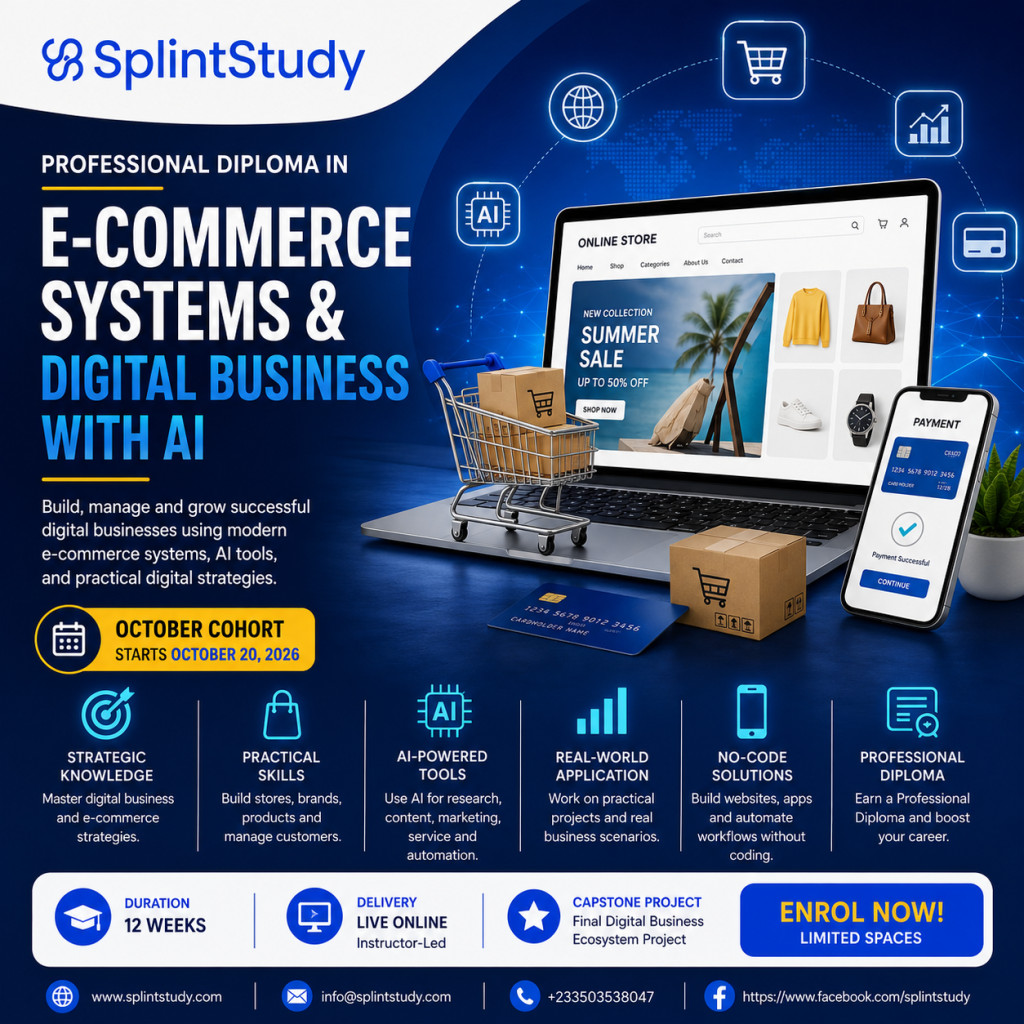
PROFESSIONAL DIPLOMA IN E-COMMERCE SYSTEMS & DIGITAL BUSINESS WITH AI
Build, Launch, Manage and Scale Digital Businesses with E-Commerce, AI, Automation and Data
The digital economy is transforming how businesses are created, marketed, operated and scaled.
Customers increasingly discover products online, communicate through digital channels, make payments electronically, interact with businesses through social media and mobile applications, and expect fast, convenient and personalized experiences.
The question is no longer whether businesses should become digital.
The real question is:
Do you have the skills to design, build, manage and grow a complete digital business ecosystem?
The Professional Diploma in E-Commerce Systems & Digital Business with AI is a comprehensive, practical and instructor-led 12-week programme designed to equip participants with the knowledge and practical skills required to build and manage modern digital businesses.
The programme goes beyond simply learning how to create an online store.
You will learn how to:
- Identify digital business opportunities.
- Develop digital business models.
- Build brand identities and logos.
- Establish digital infrastructure.
- Set up websites and e-commerce systems.
- Understand digital payments and mobile commerce.
- Apply AI to e-commerce and digital business.
- Develop digital marketing and customer acquisition strategies.
- Use social commerce and CRM.
- Design no-code mobile commerce solutions.
- Manage e-commerce operations and logistics.
- Automate business workflows.
- Use analytics and business intelligence.
- Make data-driven decisions.
- Develop strategies for growth and scalability.
You will not simply learn about digital business.
You will learn how to design it, build it, launch it, operate it, optimize it and scale it.
Programme: Professional Diploma in E-Commerce Systems & Digital Business with AI
Duration: 12 Weeks
Delivery: Live Online — Instructor-Led
Level: Beginner to Intermediate
Learning Approach: Practical, Hands-On and Project-Based
Learning Structure: Two Core Sessions Per Week
Practical Application: Guided Labs, Demonstrations and Digital Business Projects
Assessment: Practical Exercises, Module Assignments, Participation, Digital Business Projects and Final Capstone
Capstone Project: Complete Digital Business Ecosystem Project
Award: Professional Diploma
Prerequisite: No prior programming or advanced technical background required
The digital economy is creating new opportunities for entrepreneurs, professionals and organizations across virtually every industry.
From retail and professional services to education, finance, healthcare, agriculture, consulting, government and non-profit organizations, businesses increasingly need professionals who understand how digital systems work together.
However, knowing how to create a social media page or open an online store is not the same as knowing how to build a sustainable digital business.
The real value lies in knowing how to:
- Identify viable digital business opportunities.
- Understand customers and digital markets.
- Develop sustainable digital business models.
- Build a strong and consistent brand.
- Establish professional digital infrastructure.
- Create effective websites and e-commerce systems.
- Integrate digital payments.
- Use AI to improve business performance.
- Attract and convert customers.
- Manage customer relationships.
- Build mobile commerce experiences.
- Improve operational efficiency.
- Automate repetitive processes.
- Analyze business data.
- Use business intelligence for decision-making.
- Build scalable digital business ecosystems.
This programme is designed to develop precisely these capabilities.
Through live instructor-led classes, practical laboratories, guided demonstrations, industry case studies, digital business simulations and a comprehensive capstone project, participants will develop the confidence and competence to design and manage digital businesses in the modern economy.
The digital skills gap is not simply about knowing how to use individual digital tools.
Businesses need professionals who can connect:
BUSINESS STRATEGY
E-COMMERCE
DIGITAL TECHNOLOGY
AI
MARKETING
CUSTOMER EXPERIENCE
OPERATIONS
DATA
AUTOMATION
GROWTH
This programme bridges that gap.
Rather than focusing exclusively on isolated tools, the programme takes an integrated approach to digital business development.
DIGITAL BUSINESS STRATEGY
Learn how to identify digital opportunities, understand markets, develop business models and create strategies for sustainable digital growth.
BRAND & DIGITAL IDENTITY
Learn how to develop brand positioning, brand identity and logo design that create a consistent digital presence.
DIGITAL INFRASTRUCTURE
Understand domains, web hosting, corporate email, websites and the technology infrastructure required to establish a professional digital business.
E-COMMERCE SYSTEMS
Learn how to design and manage online stores, product catalogues, shopping experiences, checkout processes and digital transactions.
DIGITAL PAYMENTS
Understand payment gateways, mobile money, digital transaction workflows and payment-related security considerations.
AI-POWERED DIGITAL BUSINESS
Apply AI to product research, content creation, recommendations, customer service, marketing and business decision-making.
DIGITAL MARKETING
Develop strategies for SEO, content marketing, social media, digital advertising, marketing funnels and customer acquisition.
SOCIAL COMMERCE & CRM
Learn how to use social channels, WhatsApp Business, CRM and customer engagement strategies to build stronger customer relationships.
MOBILE COMMERCE
Explore no-code mobile app development and design mobile commerce experiences that extend beyond the traditional website.
OPERATIONS & AUTOMATION
Design efficient processes for inventory, orders, fulfilment, delivery, CRM and workflow automation.
ANALYTICS & BUSINESS INTELLIGENCE
Use KPIs, dashboards, customer insights and business intelligence to measure performance and improve decision-making.
DIGITAL TRANSFORMATION & GROWTH
Integrate all components into a scalable digital business ecosystem designed for long-term growth.
- PRACTICAL, NOT JUST THEORETICAL
Every module connects concepts and principles to practical digital business applications.
You will learn by:
- Doing.
- Building.
- Experimenting.
- Testing.
- Analysing.
- Improving.
The programme is designed to help you move from knowledge to practical implementation.
- AN INTEGRATED 12-WEEK LEARNING EXPERIENCE
The programme is structured around two core learning sessions each week.
The first session focuses on:
- Concepts.
- Principles.
- Foundations.
- Strategic thinking.
- Digital business frameworks.
The second session focuses on:
- Professional applications.
- Practical implementation.
- Digital business systems.
- Case studies.
- Guided activities.
- Practical projects.
This structure enables participants to understand both the strategic thinking behind digital business and the practical systems used to implement it.
- REAL-WORLD DIGITAL BUSINESS APPLICATION
Participants will work with scenarios drawn from:
- E-commerce.
- Retail.
- Entrepreneurship.
- SMEs.
- Professional services.
- Finance.
- Education.
- Healthcare.
- Agriculture.
- Government.
- NGOs.
- Consulting.
- Digital startups.
The goal is to help participants understand how digital business systems can be applied across different industries and organizational contexts.
- BUSINESS STRATEGY + TECHNOLOGY
The programme does not teach technology in isolation.
Participants learn how to determine:
- What digital system to use.
- When to use it.
- Why to use it.
- How systems should connect.
- How customers move through the digital ecosystem.
- How data flows through the business.
- How AI can create value.
- How automation can improve efficiency.
- How digital systems can support business growth.
- AI-POWERED E-COMMERCE
Participants explore how AI can support:
- Product research.
- Content creation.
- Product recommendations.
- Customer service.
- Marketing.
- Customer insights.
- Business analysis.
- Decision-making.
The focus is not simply on using AI tools.
The focus is on understanding how AI can be integrated into real business processes.
- NO-CODE DIGITAL DEVELOPMENT
The programme introduces participants to practical no-code and low-code approaches for developing digital business solutions.
Participants explore:
- No-code website development.
- E-commerce platforms.
- Store customization.
- No-code mobile application development.
- Digital workflows.
- Automation.
No advanced programming background is required.
- DATA, ANALYTICS & BUSINESS INTELLIGENCE
Modern digital businesses generate large amounts of data.
Participants learn how to transform data into useful information through:
- KPIs.
- Business analytics.
- Customer insights.
- Performance measurement.
- Dashboards.
- Business intelligence.
- AI-assisted analysis.
The goal is to help businesses move from simply collecting data to using data for better decisions.
- A PORTFOLIO-QUALITY CAPSTONE
The programme culminates in a comprehensive Digital Business Ecosystem Capstone Project.
Participants bring together the knowledge and practical skills developed throughout the programme to design an integrated digital business ecosystem.
The final project demonstrates the ability to connect:
- Strategy.
- Business model.
- Branding.
- Digital infrastructure.
- E-commerce.
- Payments.
- AI.
- Marketing.
- CRM.
- Mobile commerce.
- Operations.
- Automation.
- Analytics.
- Business intelligence.
- Growth.
By the end of the programme, you will be able to:
- Explain the foundations of digital business and e-commerce.
- Understand the digital economy and digital transformation.
- Identify digital business opportunities.
- Develop digital business models.
- Apply the Business Model Canvas to digital businesses.
- Understand B2B, B2C, C2C and C2B business models.
- Understand platform economics and network effects.
- Develop brand positioning and competitive advantage.
- Design professional brand identities and logos.
- Establish digital business infrastructure.
- Understand domain registration and web hosting.
- Set up professional corporate email systems.
- Plan and structure business websites.
- Understand e-commerce platforms and store systems.
- Develop and customize online stores.
- Understand digital payments and mobile money workflows.
- Apply digital security principles to e-commerce.
- Use AI for product research and content creation.
- Apply AI to customer service and recommendations.
- Develop digital marketing strategies.
- Apply SEO and SEM concepts.
- Develop content marketing strategies.
- Build customer acquisition funnels.
- Use social commerce effectively.
- Apply CRM principles to customer relationship management.
- Design customer journeys and customer experiences.
- Develop no-code mobile commerce solutions.
- Build functional no-code mobile app prototypes.
- Understand e-commerce operations and fulfilment.
- Manage inventory and order workflows.
- Understand logistics and delivery systems.
- Identify opportunities for workflow automation.
- Apply AI and automation to business processes.
- Develop business analytics frameworks.
- Identify meaningful digital business KPIs.
- Develop business intelligence dashboards.
- Use customer insights to improve decision-making.
- Apply AI-assisted business analysis.
- Develop digital business growth strategies.
- Integrate multiple digital systems into one ecosystem.
- Design a scalable digital business architecture.
- Develop and present a complete Digital Business Ecosystem Capstone Project.
This programme is designed for anyone who wants to develop practical digital business, e-commerce and AI capabilities.
It is particularly suited for:
- Entrepreneurs.
- Business Owners.
- SME Owners.
- E-commerce Professionals.
- Digital Marketers.
- Business Consultants.
- Managers and Team Leaders.
- Sales Professionals.
- Marketing Professionals.
- Business Development Professionals.
- Administrative Professionals.
- Finance and Accounting Professionals.
- Educators and Trainers.
- Technology and Business Professionals.
- Digital Transformation Professionals.
- Project Managers.
- Freelancers.
- Startup Founders.
- University Students and Recent Graduates.
- Professionals preparing for leadership roles.
- Professionals seeking to future-proof their careers.
- Anyone interested in building or managing a digital business.
No prior programming knowledge is required.
The programme is designed to be accessible to participants from diverse academic, professional and entrepreneurial backgrounds.
The programme combines live instruction with practical application.
Your learning experience includes:
- Live instructor-led online sessions.
- Interactive lectures.
- Guided demonstrations.
- Practical digital business laboratories.
- E-commerce system activities.
- Website and store development activities.
- Brand and logo design exercises.
- AI-powered business applications.
- Digital marketing activities.
- No-code mobile app development.
- Customer journey mapping.
- CRM activities.
- Business simulations.
- Real-world industry case studies.
- Digital business strategy exercises.
- Business Model Canvas activities.
- Analytics and dashboard exercises.
- Automation workflow design.
- Professional templates and frameworks.
- Individual activities.
- Collaborative group activities.
- Instructor feedback.
- Capstone development.
- Final capstone presentation and defence.
Participants are encouraged to apply what they learn to real businesses, business ideas, organizations or professional contexts.
You will graduate with:
KNOWLEDGE
A strong understanding of digital business, e-commerce systems, digital transformation and the digital economy.
BUSINESS SKILLS
The ability to identify opportunities, develop business models and create digital business strategies.
BRANDING CAPABILITY
The ability to develop brand identities, logos and consistent digital brand experiences.
E-COMMERCE CAPABILITY
The ability to design and manage digital stores, e-commerce systems and transaction workflows.
AI CAPABILITY
The ability to apply AI to e-commerce, marketing, customer experience and business decision-making.
DIGITAL MARKETING CAPABILITY
The ability to develop strategies for customer acquisition, content, SEO, social media and digital campaigns.
CUSTOMER EXPERIENCE CAPABILITY
The ability to use CRM, social commerce and customer journey strategies to build stronger relationships.
MOBILE COMMERCE CAPABILITY
The ability to design no-code mobile commerce solutions and app prototypes.
OPERATIONS CAPABILITY
The ability to understand inventory, orders, fulfilment, logistics and digital business operations.
AUTOMATION CAPABILITY
The ability to identify and design opportunities for workflow and process automation.
ANALYTICS CAPABILITY
The ability to use KPIs, dashboards, analytics and business intelligence for better decision-making.
GROWTH CAPABILITY
The ability to develop strategies for customer acquisition, retention, optimization and digital business growth.
DIGITAL TRANSFORMATION CAPABILITY
The ability to integrate multiple digital systems into a coherent and scalable digital business ecosystem.
PROFESSIONAL CREDENTIAL
A Professional Diploma demonstrating successful completion of the programme.
UNDERSTAND DIGITAL BUSINESS
Learn the foundations of the digital economy and e-commerce.
↓
DESIGN THE BUSINESS
Develop digital business models and identify opportunities.
↓
BUILD THE BRAND
Create a professional brand identity and digital presence.
↓
BUILD THE DIGITAL FOUNDATION
Establish websites, infrastructure and e-commerce systems.
↓
ENABLE TRANSACTIONS
Understand digital payments and mobile commerce.
↓
APPLY AI
Use AI to improve digital business performance.
↓
ATTRACT CUSTOMERS
Develop digital marketing and customer acquisition strategies.
↓
BUILD RELATIONSHIPS
Use social commerce, CRM and customer experience strategies.
↓
GO MOBILE
Design no-code mobile commerce experiences.
↓
OPERATE & AUTOMATE
Improve operations and automate business processes.
↓
MEASURE & OPTIMIZE
Use analytics, KPIs and business intelligence.
↓
GROW
Develop scalable digital business strategies.
↓
INTEGRATE
Bring everything together into one digital business ecosystem.
↓
BUILD THE FUTURE
Develop and present your Complete Digital Business Ecosystem.
At SplintStudy, we believe professional education should go beyond theory.
Our approach combines structured learning with practical application to help participants develop skills that can be used in the real world.
Our programmes are designed to help participants:
- Build future-ready digital capabilities.
- Develop practical e-commerce skills.
- Build and manage digital businesses.
- Improve workplace productivity.
- Apply AI to business challenges.
- Develop digital marketing capabilities.
- Build professional brands.
- Design digital customer experiences.
- Automate business processes.
- Use data for better decisions.
- Develop business intelligence capabilities.
- Create scalable digital systems.
- Support digital transformation.
- Build evidence of practical competence.
- Prepare for the evolving digital economy.
Our focus is not simply on teaching people how to use digital tools.
Our goal is to help participants develop the knowledge, confidence, practical skills and strategic capability to build and manage successful digital businesses.
The future of business is increasingly digital.
The opportunity is not simply to put a business online.
The opportunity is to learn how to:
BUILD WITH DIGITAL TECHNOLOGY.
SELL THROUGH E-COMMERCE.
GROW THROUGH DIGITAL MARKETING.
ENGAGE CUSTOMERS THROUGH SOCIAL COMMERCE.
CREATE MOBILE EXPERIENCES.
IMPROVE OPERATIONS THROUGH AUTOMATION.
USE AI TO CREATE VALUE.
MAKE BETTER DECISIONS WITH DATA.
SCALE THROUGH DIGITAL BUSINESS SYSTEMS.
Whether you want to:
- Launch an online business.
- Build an e-commerce store.
- Grow an existing business.
- Develop digital products and services.
- Improve your digital marketing.
- Use AI to transform your business.
- Automate repetitive processes.
- Build a mobile commerce solution.
- Improve customer experience.
- Use analytics for better decisions.
- Lead digital transformation.
- Prepare for the future of business.
This programme provides a structured pathway to develop practical and strategic digital business capabilities.
ENROL TODAY
Learn Digital Business.
Build E-Commerce Systems.
Apply AI.
Market Digitally.
Automate Operations.
Use Data.
Build.
Launch.
Grow.
Scale.
Take the next step toward becoming a digital business professional ready to create, manage and grow businesses in an increasingly digital and AI-powered economy.
Course Syllabus
THE 12-WEEK PROGRAMME CURRICULUM
Focus
Build a strong foundation in digital business, e-commerce, digital transformation and the digital economy.
Key Topics
- Introduction to digital business.
- Understanding e-commerce.
- Digital transformation.
- The digital economy.
- Digital business opportunities.
- Digital business ecosystems.
- E-commerce trends.
- Digital customer behaviour.
- Digital value creation.
- Digital business strategy.
Practical Application
Participants identify a digital business opportunity and assess how digital technologies can create value.
Practical Assignment
Digital Business Opportunity Assessment
Identify a business opportunity and develop a preliminary digital business concept.
Focus
Understand how digital businesses create, deliver and capture value.
Key Topics
- Digital business models.
- B2B.
- B2C.
- C2C.
- C2B.
- Platform business models.
- Marketplace models.
- Subscription models.
- Freemium models.
- Platform economics.
- Network effects.
- Business Model Canvas.
Practical Application
Participants develop a digital business model using the Business Model Canvas.
Practical Assignment
Digital Business Model Canvas
Develop a complete digital business model for a real or simulated business.
Focus
Develop a strong and consistent brand identity for a digital business.
Key Topics
- Brand strategy.
- Brand positioning.
- Competitive advantage.
- Customer value.
- Brand identity.
- Brand personality.
- Brand messaging.
- Visual identity.
- Logo design.
- Digital brand consistency.
- AI-assisted branding.
Practical Application
Participants develop:
- Brand identity.
- Logo concept.
- Brand positioning.
- Brand messaging.
- Visual identity.
Practical Assignment
Digital Brand Identity Project
Develop a complete brand identity and logo concept for a real or simulated digital business.
Focus
Build the digital infrastructure required to establish a professional online business.
Key Topics
- Domain registration.
- Web hosting.
- Corporate email.
- Website strategy.
- Website structure.
- E-commerce platforms.
- Store architecture.
- Product catalogue structure.
- Website strategy.
- No-code and low-code website development.
- Store customization.
Practical Application
Participants develop or structure:
- Domain.
- Hosting plan.
- Corporate email.
- Website.
- E-commerce store.
- Product catalogue.
- Store navigation.
Practical Assignment
Digital Business Website & E-Commerce Setup Project
Develop a functional website or e-commerce store structure for a real or simulated business.
Focus
Understand how digital businesses process transactions securely and conveniently.
Key Topics
- Digital payment systems.
- Payment gateways.
- Mobile money.
- Card payments.
- Bank transfers.
- Payment workflows.
- Checkout systems.
- Transaction confirmation.
- E-commerce security.
- Cybersecurity and risk.
Practical Application
Participants design:
- Payment workflows.
- Checkout processes.
- Transaction flows.
- Payment confirmation processes.
Practical Assignment
Digital Payment & Transaction Workflow
Design a complete payment and transaction workflow for an e-commerce business.
Focus
Explore how Artificial Intelligence can improve e-commerce and digital business performance.
Key Topics
- AI in e-commerce.
- AI product research.
- AI-assisted content creation.
- Product descriptions.
- AI recommendations.
- Personalization.
- AI customer service.
- AI chatbots and assistants.
- AI-powered business analysis.
- AI-driven customer insights.
Practical Application
Participants use AI to develop:
- Product research.
- Product content.
- Marketing content.
- Customer service concepts.
- AI-assisted recommendations.
Practical Assignment
AI-Powered E-Commerce Strategy
Develop an AI strategy showing how AI can improve a real or simulated digital business.
Focus
Develop strategies for attracting, engaging and converting digital customers.
Key Topics
- Digital marketing.
- SEO.
- SEM.
- Content marketing.
- Social media marketing.
- Digital advertising.
- Marketing funnels.
- Customer acquisition.
- Conversion optimization.
- AI-assisted content.
- Campaign development.
Practical Application
Participants develop:
- Digital marketing strategies.
- Content plans.
- Marketing campaigns.
- Customer acquisition funnels.
Practical Assignment
Digital Customer Acquisition Campaign
Develop an integrated digital marketing campaign designed to attract and convert target customers.
Focus
Build stronger customer relationships using social commerce, CRM and digital customer experience strategies.
Key Topics
- Social commerce.
- WhatsApp Business.
- Social selling.
- Customer journey mapping.
- CRM.
- Customer engagement.
- Personalization.
- Customer service.
- Retention.
- Loyalty.
- Customer experience.
Practical Application
Participants develop:
- Customer journey maps.
- WhatsApp Business strategies.
- CRM workflows.
- Customer engagement strategies.
- Retention strategies.
Practical Assignment
Social Commerce & Customer Experience Strategy
Develop a strategy for using social channels, CRM and customer engagement to increase customer acquisition and retention.
Focus
Explore how businesses can extend their digital presence through no-code mobile applications.
Key Topics
- Mobile commerce.
- Mobile customer experience.
- Mobile app strategy.
- No-code development.
- Low-code development.
- App structure.
- User experience.
- Mobile shopping.
- Customer accounts.
- Mobile engagement.
- Omnichannel strategy.
Practical Application
Participants develop a functional no-code mobile app prototype.
Practical Assignment
No-Code Mobile Commerce App Prototype
Design and develop a functional prototype of a mobile application that supports a digital business or e-commerce experience.
Focus
Develop efficient systems for managing the operational side of digital businesses.
Key Topics
- E-commerce operations.
- Inventory management.
- Order management.
- Fulfilment.
- Logistics.
- Delivery.
- Returns.
- Customer service.
- Workflow automation.
- CRM automation.
- AI-assisted operations.
Practical Application
Participants design:
- Order workflows.
- Inventory processes.
- Fulfilment workflows.
- Delivery processes.
- Automation opportunities.
Practical Assignment
E-Commerce Operations & Automation Blueprint
Develop an operational workflow and identify opportunities for automation across the customer and fulfilment journey.
Focus
Use data, analytics and business intelligence to measure performance and drive growth.
Key Topics
- E-commerce analytics.
- Business KPIs.
- Sales metrics.
- Marketing metrics.
- Customer metrics.
- Conversion rates.
- Customer acquisition cost.
- Customer lifetime value.
- Retention.
- Dashboards.
- Business intelligence.
- Customer insights.
- AI-assisted decision-making.
- Growth strategies.
Practical Application
Participants develop:
- KPI frameworks.
- Analytics dashboards.
- Customer insights.
- AI-assisted business recommendations.
- Growth strategies.
Practical Assignment
Digital Business Analytics & Growth Dashboard
Develop a KPI framework and dashboard that can be used to monitor performance and support data-driven decisions.
Focus
Bring together the knowledge and practical skills developed throughout the programme to design a complete digital business ecosystem.
Key Topics
- Digital business ecosystem integration.
- Customer journey integration.
- Business model integration.
- E-commerce integration.
- Payment integration.
- CRM integration.
- AI integration.
- Automation.
- Data flow.
- Analytics and BI.
- Digital transformation.
- Scalability.
- Growth strategy.
- Capstone development.
- Capstone presentation and defence.
Practical Application
Participants develop and present a complete digital business ecosystem integrating:
- Business strategy.
- Business model.
- Brand.
- Digital infrastructure.
- Website.
- E-commerce.
- Payments.
- AI.
- Digital marketing.
- Social commerce.
- CRM.
- Mobile commerce.
- Operations.
- Automation.
- Analytics.
- Business intelligence.
- Growth strategy.
Practical Assignment
Final Digital Business Ecosystem Capstone Project
Design and present a complete digital business ecosystem for a real or simulated business.
FINAL CAPSTONE PROJECT
COMPLETE DIGITAL BUSINESS ECOSYSTEM
The programme culminates in a comprehensive practical capstone project.
Participants select a real business, business idea, organization or simulated digital business and develop an integrated digital business ecosystem.
The project requires participants to move from identifying a business opportunity to designing a practical pathway for creating, launching, operating and scaling a digital business.
THE CAPSTONE INCLUDES:
- Business Overview and Opportunity.
- Market and Customer Analysis.
- Digital Business Strategy.
- Business Model.
- Brand Strategy and Identity.
- Logo and Visual Identity.
- Digital Infrastructure.
- Website Strategy.
- E-Commerce System.
- Digital Payment Workflow.
- AI Integration Strategy.
- Digital Marketing Strategy.
- Social Commerce Strategy.
- CRM and Customer Experience.
- No-Code Mobile Commerce App.
- Operations and Fulfilment.
- Automation Strategy.
- Analytics and KPI Framework.
- Business Intelligence Dashboard.
- Growth Strategy.
- Digital Business Ecosystem Map.
- Implementation Roadmap.
- Final Professional Presentation and Defence.
THE FINAL DIGITAL BUSINESS ECOSYSTEM FOLLOWS:
IDEA
↓
STRATEGY
↓
BUSINESS MODEL
↓
BRAND
↓
DIGITAL INFRASTRUCTURE
↓
E-COMMERCE
↓
PAYMENTS
↓
MARKETING
↓
CUSTOMERS
↓
CRM
↓
MOBILE COMMERCE
↓
OPERATIONS
↓
AUTOMATION
↓
ANALYTICS
↓
BUSINESS INTELLIGENCE
↓
AI
↓
GROWTH
↓
INTEGRATION
↓
DIGITAL BUSINESS ECOSYSTEM
The capstone demonstrates the participant's ability to move beyond simply understanding e-commerce tools and digital platforms to thinking strategically about how digital technologies, AI, data and business systems can work together to create measurable business value.
$599.00 $249.00
Time Limited
Includes
- Live instructor-led sessions.
- Digital business concepts and principles.
- E-commerce strategy.
- Business model development.
- Brand development.
- Website and store development.
- Practical digital business laboratories.
- Guided demonstrations.
- AI-powered business applications.
- Digital marketing activities.
- CRM and customer experience exercises.
- No-code mobile app development.
- Operations and automation.
- Analytics and business intelligence.
- Real-world case studies.
- Weekly practical exercises.
- Module assignments.
- Professional templates.
- Business simulations.
- Individual activities.
- Collaborative group activities.
- Instructor feedback.
- Capstone development.
- Final capstone presentation.
- ChatGPT.
- Google Gemini.
- Microsoft Copilot.
- AI-powered business analysis.
- AI content generation.
- AI customer service.
- AI product research.
- AI-assisted decision-making.
- Canva.
- Canva AI.
- AI-assisted logo and brand development.
- AI-assisted content creation.
- Digital design technologies.
- Domain registration platforms.
- Web hosting platforms.
- Website builders.
- No-code and low-code website tools.
- E-commerce platforms.
- Store customization technologies.
- Search engine optimization tools.
- Digital advertising platforms.
- Social media platforms.
- Content marketing technologies.
- Marketing analytics tools.
- WhatsApp Business.
- CRM platforms.
- Customer engagement tools.
- Social commerce platforms.
- No-code mobile app development platforms.
- Low-code development concepts.
- Mobile commerce technologies.
- Digital payment gateways.
- Mobile money.
- Card payment systems.
- Digital transaction workflows.
- Website analytics.
- E-commerce analytics.
- KPI dashboards.
- Business intelligence platforms.
- AI-assisted data analysis.
- Workflow automation platforms.
- No-code automation.
- AI-powered workflows.
- CRM automation.
- Business process automation concepts.
- Evaluate digital tools.
- Select appropriate technologies.
- Combine different systems.
- Integrate digital workflows.
- Apply AI effectively.
- Automate processes.
- Use data.
- Build scalable digital ecosystems.
- Digital Business Opportunity Assessment.
- Digital Business Model Canvas.
- Brand Identity.
- Logo Design.
- Digital Infrastructure Plan.
- Website.
- E-Commerce Store.
- Digital Payment Workflow.
- AI-Powered E-Commerce Strategy.
- Digital Marketing Campaign.
- Customer Acquisition Funnel.
- Social Commerce Strategy.
- CRM Workflow.
- Customer Journey Map.
- No-Code Mobile App Prototype.
- E-Commerce Operations Blueprint.
- Automation Workflows.
- Analytics Dashboard.
- Business Intelligence Framework.
- Digital Business Growth Strategy.
- Complete Digital Business Ecosystem.
- Final Capstone Project.
- E-commerce.
- Artificial Intelligence.
- Digital marketing.
- Mobile commerce.
- CRM.
- Operations.
- Automation.
- Analytics.
- Business intelligence.
- Growth strategy.
- Meet the minimum attendance requirement.
- Complete required practical exercises.
- Complete module assignments.
- Participate in practical activities.
- Complete the Digital Business Project.
- Successfully complete the Final Digital Business Ecosystem Capstone.
- Present and defend the final capstone project.
- Meet the programme's minimum assessment requirements.
- E-commerce systems.
- Digital business strategy.
- Artificial Intelligence.
- Digital marketing.
- Mobile commerce.
- Automation.
- Analytics.
- Business intelligence.
- Identify and evaluate digital business opportunities.
- Design digital business models.
- Create professional digital brands.
- Develop e-commerce systems.
- Implement digital payment solutions.
- Use AI to improve digital business performance.
- Create digital marketing strategies.
- Develop customer acquisition systems.
- Build CRM and customer experience workflows.
- Create no-code mobile commerce solutions.
- Design operational and automation workflows.
- Use analytics and business intelligence for decision-making.
- Develop scalable digital business ecosystems.
Every week combines:
The programme follows a structured learning model:
SESSION 1
Concepts, Principles & Foundations
SESSION 2
Strategies, Frameworks, Professional Applications & Practical Implementation
This ensures participants develop both conceptual understanding and practical capability.
Participants will gain practical exposure to a range of digital business, e-commerce, AI, marketing, design, mobile development and automation technologies.
AI & GENERATIVE AI
BRANDING & CREATIVE TOOLS
WEBSITE & E-COMMERCE TECHNOLOGIES
DIGITAL MARKETING
CUSTOMER & CRM TECHNOLOGIES
MOBILE COMMERCE
PAYMENTS
ANALYTICS & BUSINESS INTELLIGENCE
AUTOMATION & WORKFLOW
IMPORTANT
The digital technology landscape evolves rapidly.
Specific platforms and tools introduced during the programme may be updated or replaced to ensure participants are exposed to relevant and emerging technologies.
The focus is not simply on memorizing individual platforms.
The focus is on developing the ability to:
Throughout the programme, you will build a portfolio of practical digital business work.
Your portfolio may include:
By the end of the programme, you will have more than a diploma.
You will have evidence of your ability to design and develop practical digital business systems.
Your progress will be evaluated through continuous practical assessment.
WEEKLY PRACTICAL EXERCISES
20%
Apply concepts, frameworks and digital tools through practical activities.
MODULE ASSIGNMENTS
20%
Complete structured assignments based on the 12 programme modules.
PARTICIPATION & ATTENDANCE
10%
Participate actively in live sessions, discussions, practical activities and collaborative learning.
DIGITAL BUSINESS PROJECT
20%
Develop and demonstrate an integrated digital business component or workflow.
FINAL DIGITAL BUSINESS ECOSYSTEM CAPSTONE
30%
Develop and present a comprehensive digital business ecosystem integrating:
TOTAL
100%
Upon successful completion of the programme, participants will receive:
PROFESSIONAL DIPLOMA IN
E-COMMERCE SYSTEMS & DIGITAL BUSINESS WITH AI
To qualify for the diploma, participants must:
The diploma recognizes the successful completion of a structured professional programme focused on the practical application of:
This programme prepares participants to design, build and manage practical digital business ecosystems that combine technology, strategy, customer experience and data-driven decision-making.
By completing the programme, participants will be able to:
Participants graduate with practical experience in transforming ideas into functioning digital business systems.
IDEA
↓
STRATEGY
↓
BUSINESS MODEL
↓
BRAND
↓
DIGITAL INFRASTRUCTURE
↓
E-COMMERCE
↓
PAYMENTS
↓
MARKETING
↓
CUSTOMERS
↓
CRM
↓
MOBILE COMMERCE
↓
OPERATIONS
↓
AUTOMATION
↓
ANALYTICS
↓
BUSINESS INTELLIGENCE
↓
AI
↓
GROWTH
↓
INTEGRATION
↓
DIGITAL BUSINESS ECOSYSTEM
The programme demonstrates the participant's ability to move beyond simply using e-commerce platforms and digital tools to strategically design integrated digital businesses powered by technology, AI, data and automation.